
The Physics of Grip and Gravity
There is a distinct moment in Tasman Driftline where you realise that the car is no longer just a vehicle, but an extension of your own nervous system. Hurtling down a sodden, gravel-strewn coastal mountain road in a heavily tuned rally coupe, the rain lashing against the windscreen and the spray from your rivals obscuring the apex, the game asks a simple question: do you trust your tyres? The answer is never straightforward. In this sim-leaning rally racer, grip is not a binary state of traction or slipping; it is an ongoing, dynamic conversation between the rubber, the road surface, and the ever-shifting weight of the chassis. As you feather the throttle and coax the steering wheel, the feedback is nothing short of extraordinary.
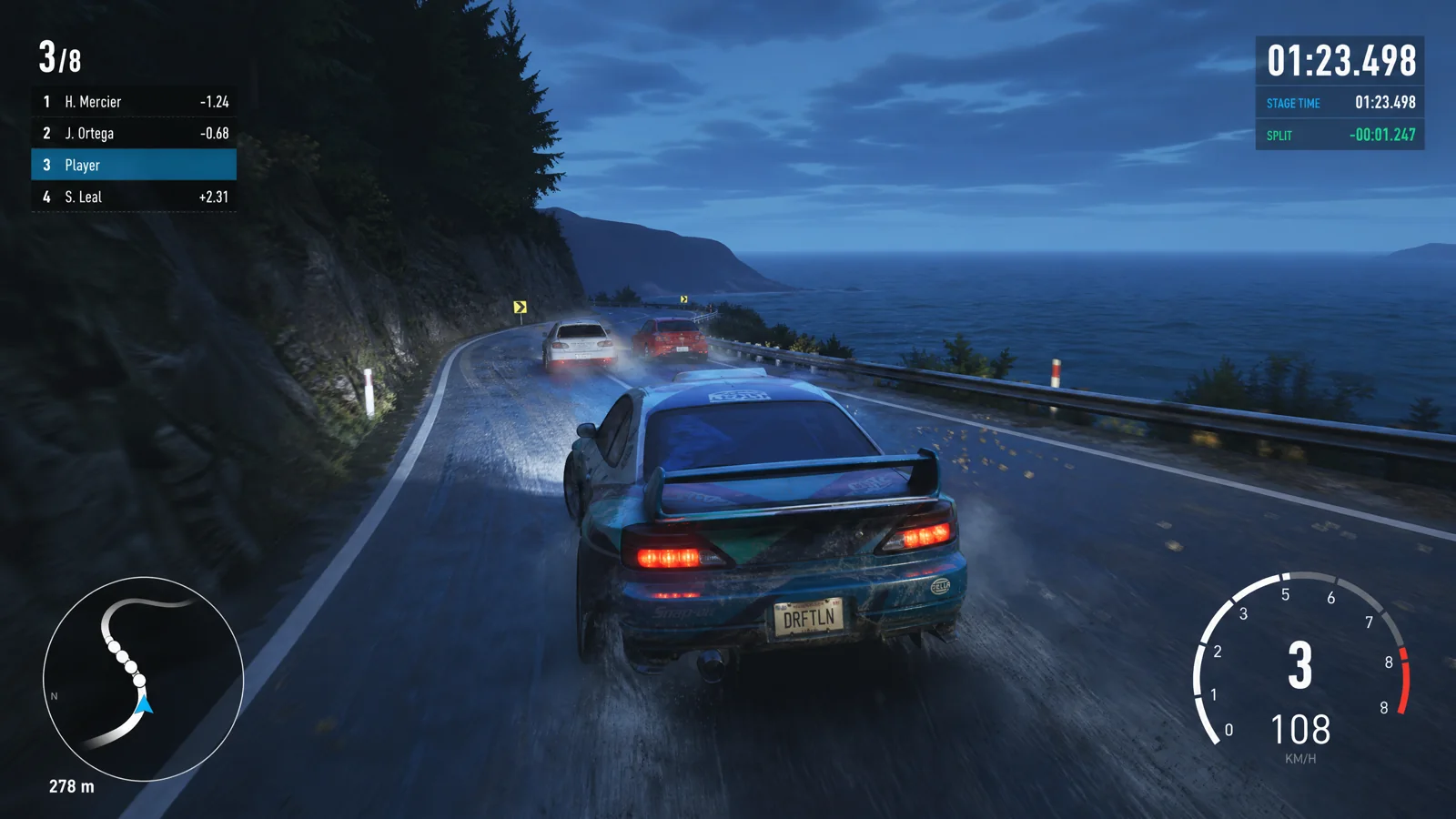
Weight transfer is the undisputed star of the show here. Whether you are throwing the car into a hairpin or attempting to maintain momentum through a series of sweeping S-bends, you can feel the mass of the vehicle shifting from corner to corner. When you hit the brakes, the nose dives; when you accelerate, the rear squats. This is not just a visual effect; it fundamentally alters how the car behaves. If you turn in too sharply while the weight is over the front wheels, the rear will inevitably step out, initiating a slide that you must catch with rapid counter-steering and precise throttle application. The HUD, cleanly displaying your speed, current gear, stage time, and a minimalist minimap, provides just enough information without distracting from the visceral experience of the drive.
Equally impressive is the readability of the road surfaces. Tasman Driftline features a diverse array of environments, from sun-baked tarmac to treacherous mud, and each surface demands a unique approach. You can visually identify patches of loose gravel or standing water, and the game’s physics engine responds accordingly. The transition from tarmac to dirt is jarring in the best possible way, requiring immediate adjustments to your driving style. The wet coastal mountain roads, in particular, are a standout. The visual representation of the damp surface, combined with the way the tyres struggle for purchase, creates a tension that is palpable.
The Career Mode Conundrum
While the on-track action is near flawless, the overarching career mode introduces a few unexpected hurdles. Tasman Driftline attempts to simulate the off-track responsibilities of a professional rally driver, placing a heavy emphasis on team management and sponsorship negotiations. In theory, this adds a welcome layer of depth to the experience, allowing you to build your own racing empire from the ground up. You are tasked with hiring mechanics, upgrading your facilities, and courting sponsors to fund your increasingly expensive automotive habits. However, the execution leaves much to be desired. The sponsorship menus, in particular, are needlessly overcomplicated, buried beneath layers of unintuitive UI and dense spreadsheets.
Instead of a streamlined system that lets you focus on the racing, you are forced to navigate a labyrinthine series of contracts, each with its own convoluted set of objectives and payout structures. Do you sign with a tyre manufacturer that demands top-three finishes on gravel stages, or a beverage company that pays out based on the number of overtakes? The sheer volume of variables makes it difficult to make informed decisions, and the interface does little to clarify the long-term implications of your choices. It is a frustrating blemish on an otherwise stellar package, turning what should be an engaging strategic layer into a tedious administrative chore.
Despite these administrative frustrations, the pacing of the career mode is generally well-judged. You start in lower-tier, front-wheel-drive hatchbacks, learning the fundamentals of weight transfer and momentum before graduating to the terrifyingly fast, all-wheel-drive monsters of the premier classes. This gradual escalation ensures that you are never overwhelmed by the sheer speed of the vehicles, allowing you to develop your skills at a natural, satisfying cadence. The sense of progression is tangible, and there is a genuine sense of accomplishment when you finally master a particularly demanding vehicle or conquer a notoriously difficult stage.
Performance and Accessibility
On a technical level, Tasman Driftline is a remarkable achievement. Tested on the PlayStation 5, the game maintains a rock-solid sixty frames per second, even when the screen is filled with volumetric rain, dense foliage, and the chaotic spray of half a dozen rival cars. The lighting engine is particularly noteworthy, accurately simulating the harsh glare of the midday sun or the eerie, diffuse light of a misty morning. The sound design is equally impressive, with the guttural roar of the engines and the percussive rattle of gravel against the undercarriage providing vital audio cues about the state of your vehicle and the road surface.
"The feedback is so nuanced that you can almost feel the individual stones shifting beneath your tyres, transforming the simple act of driving into a deeply tactile experience."
Accessibility is another area where the game excels. Sim-leaning racers can often be intimidating for newcomers, but Tasman Driftline offers a comprehensive suite of driving aids and difficulty toggles that allow you to tailor the experience to your skill level. You can adjust the severity of the damage modelling, enable traction control and anti-lock brakes, and fine-tune the AI behaviour. Crucially, the game does not penalise you for using these assists, ensuring that everyone can enjoy the thrill of the rally, regardless of their experience level.
Systems and Mechanics
Beneath the surface, the game is driven by a complex web of interlocking systems. The tuning mechanics are deep and rewarding, allowing you to adjust everything from the suspension stiffness to the gear ratios. Spending time in the garage tinkering with your setup can yield significant dividends on the track, shaving precious seconds off your stage times.
To give you an idea of what to expect, here is a quick breakdown of the core gameplay elements:
- Weight Transfer: The defining characteristic of the handling model, requiring precise throttle and brake inputs to manage the chassis.
- Surface Degradation: The road surface changes dynamically as cars pass over it, creating ruts and exposing loose gravel.
- Dynamic Weather: Rain, snow, and fog can roll in mid-stage, drastically altering visibility and grip levels.
These systems work in concert to create an experience that is both demanding and immensely satisfying. When you finally string together a perfect sector, dancing the car on the edge of adhesion through a series of treacherous corners, the feeling of triumph is unparalleled.
The Final Verdict
Tasman Driftline is a triumph of digital engineering, a game that understands the visceral, terrifying appeal of throwing a car down a narrow, treacherous road at breakneck speeds. The physics engine is a work of art, delivering a handling model that is both punishingly realistic and incredibly rewarding to master. The way the car communicates with the driver, telegraphing every bump, dip, and loss of traction, is nothing short of revelatory.
Yes, the career mode is marred by a needlessly complex sponsorship system that bogs down the pacing with administrative busywork. The menus are a chore to navigate, and the strategic layer feels disjointed from the on-track action. But these flaws are easily forgiven once you are behind the wheel. The sheer joy of the driving experience, the spectacular visual presentation, and the robust suite of accessibility options make this a must-play for anyone with even a passing interest in motorsport.