
A Journey Defined by the Horizon
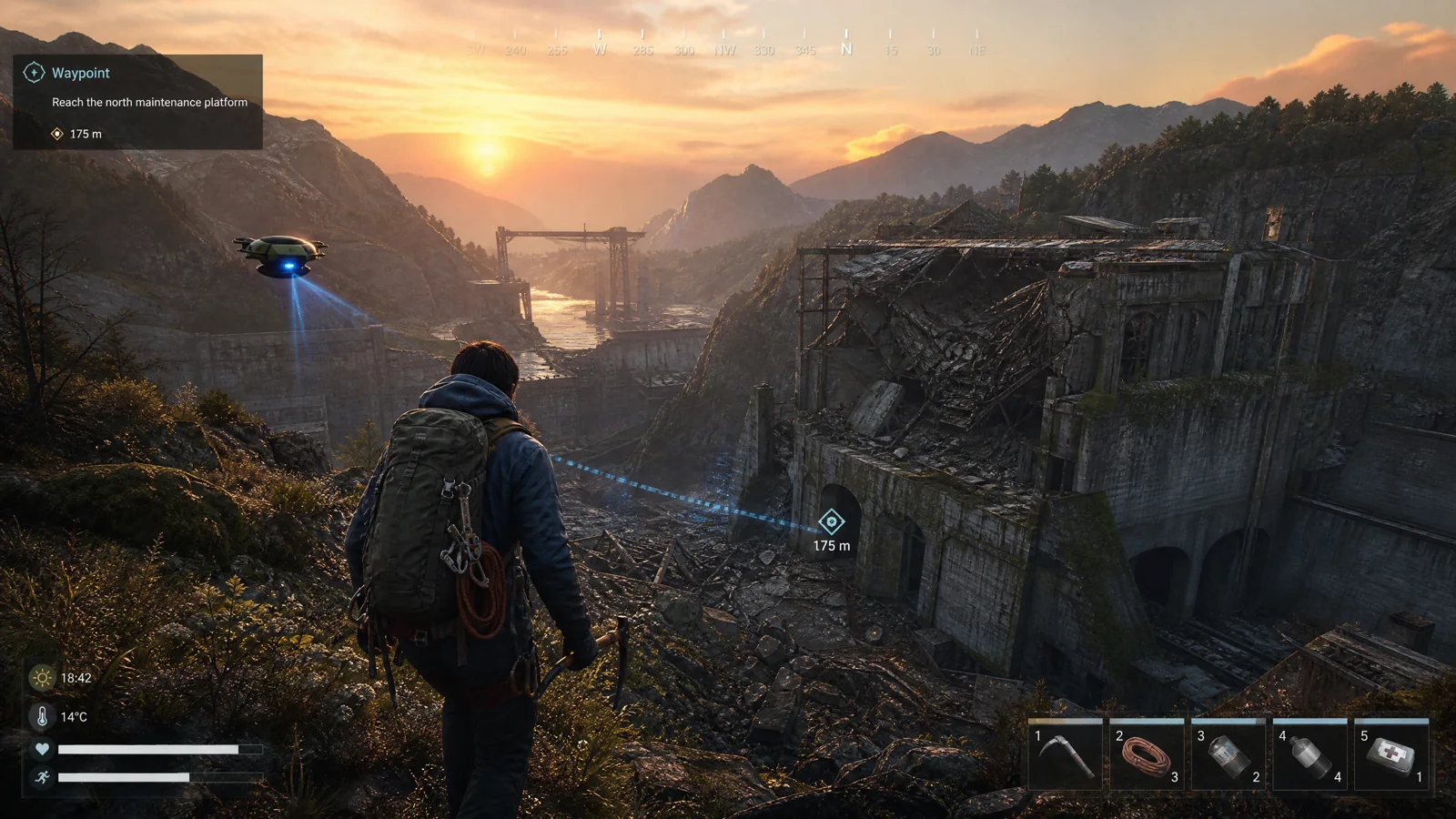
There is a distinct chill in the air when you first set foot in the sprawling, desolate valleys of South Island Afterlight. It is a survival exploration game that strips away the busywork often associated with the genre, asking you instead to look up at the sky and read the clouds. Developed for PC, PlayStation 5, and Xbox Series consoles, this ambitious title leans heavily into the psychological weight of isolation and the tangible consequences of poor preparation. You play as an unnamed third-person explorer, equipped with little more than a heavy pack, a versatile climbing tool, and a companion drone that hums quietly over your shoulder. As you cross an abandoned hydro valley at sunset, the rusted remnants of old infrastructure stand in stark contrast to the encroaching wilderness, framing a journey that is as beautiful as it is unforgiving.
At its core, South Island Afterlight argues that route planning and weather observation matter far more than the traditional crafting grind. The game eschews the tedious loop of punching trees and hoarding resources. Instead, your primary adversary is the environment itself, and your greatest asset is foresight. Before setting out from any temporary camp, you must carefully study the topographical map and assess the shifting weather patterns. A sudden southerly storm can plummet temperatures in minutes, and if you are caught halfway up a sheer cliff face without adequate thermal gear, the consequences are swift and severe. The tension here does not come from fending off mutated beasts, but from the quiet, creeping realisation that you misjudged the distance to the next shelter.
The on-screen HUD is a masterclass in minimalist design, providing just enough information to keep you alive without breaking the immersion. A stamina bar, temperature gauge, inventory slots, and a subtle waypoint indicator are all you have to guide you. The companion drone acts as both a scout and an environmental analyser, pinging structural weaknesses in the old hydro dams or warning you of incoming pressure drops. Controlling the explorer feels deliberate and weighty. Every step through deep mud or up a steep incline drains your stamina, and managing your physical exertion is just as critical as managing your inventory. The climbing mechanics are tactile, requiring you to rhythmically alternate triggers to find purchase on rocky outcrops, making every ascent feel like a hard-won victory.
The Mechanics of Survival
Where many survival games falter is in their pacing, often overwhelming the player with constant, urgent demands. South Island Afterlight takes a more measured approach. The early hours are spent mastering the basics of navigation and learning to interpret the subtle audio and visual cues of the world. The crunch of frost underfoot, the direction of the wind bending the tussock grass, and the shifting colours of the sunset all provide vital information. The game’s systems are deeply intertwined. For instance, your climbing tool requires maintenance, but rather than crafting endless repair kits, you must scavenge parts from the abandoned machinery scattered across the valley. This encourages exploration and rewards players who take the time to investigate their surroundings.
The inventory system is refreshingly restrictive. You cannot carry an entire hardware store in your backpack. Every item has weight and volume, forcing you to make difficult choices before every excursion. Do you pack extra climbing pitons for a more direct, vertical route, or do you carry more high-energy rations and take the longer, safer path around the valley? These decisions give the gameplay a cerebral edge, elevating it above mere resource management.
"The true challenge of the wilderness is not in conquering it, but in understanding your own limitations and planning accordingly. The landscape is indifferent; it is your preparation that decides your fate."
However, the game is not without its flaws. As you transition into the middle act of the narrative, the pacing begins to drag, primarily due to a lack of environmental variety in the safe zones. You will find yourself repeatedly encountering only two types of shelter: dilapidated maintenance sheds and natural cave overhangs. While these locations serve their mechanical purpose, providing a place to rest and review your map, the repetition dulls the sense of discovery. You begin to anticipate exactly what resources you will find in each shed, which slightly undermines the tension the game works so hard to build in its opening hours.
Performance and Accessibility
From a technical standpoint, South Island Afterlight is a stunning achievement, particularly on the PlayStation 5 and Xbox Series X, where it targets a smooth 60 frames per second. The lighting engine is the real star of the show. As the sun dips below the mountains, casting long, purple shadows across the valley, the atmosphere is palpable. The dynamic weather system is not just a visual treat; it fundamentally alters the geometry of the world. Rain slicks the rock faces, making climbing perilous, while snow obscures pathways and drains your body heat at an alarming rate. On PC, the game offers a wide range of graphical settings, allowing players to tailor the experience to their hardware.
Accessibility has clearly been a priority for the developers. The game features a robust suite of options designed to make the harsh wilderness more welcoming. Players can adjust the severity of the temperature and stamina drain, customise the HUD colour palette for colour-blindness, and enable a high-contrast mode that highlights climbable surfaces and essential items. The controls are fully remappable, and there is an option to toggle the rhythmic climbing mechanics to a simple hold-button action, which is a welcome addition for players with mobility issues.
Key Gameplay Features
- Dynamic Weather System: Real-time changes in temperature, wind, and precipitation that directly impact traversal and survival.
- Tactile Climbing: Trigger-based climbing mechanics that require careful stamina management and route selection.
- Companion Drone: Assists with scouting, environmental analysis, and identifying structural weaknesses in abandoned infrastructure.
- Minimalist HUD: Unobtrusive displays for stamina, temperature, inventory, and waypoints that keep the focus on the environment.
- Weight-Based Inventory: Restrictive carrying capacity that forces strategic decisions about gear and provisions.
The Final Ascent
The narrative of South Island Afterlight is delivered almost entirely through environmental storytelling and the silent companionship of your drone. There are no lengthy cutscenes or exposition dumps. Instead, you piece together the history of the hydro valley through discarded notes, rusted machinery, and the sheer scale of the abandoned project. The isolation is a character in itself, and the game excels at making you feel incredibly small in a vast, indifferent world.
Despite the repetitive shelter designs in the middle act, the game’s core loop of observation, planning, and execution remains deeply satisfying. When you finally reach a high vantage point after a gruelling climb, look back over the valley you just crossed, and watch the weather roll in, the sense of accomplishment is profound. The game does not hold your hand, but it gives you all the tools you need to survive, provided you are willing to pay attention.
In a genre often cluttered with crafting menus and base-building mechanics, South Island Afterlight stands out as a focused, atmospheric experience. It strips away the excess to deliver a pure survival exploration game where your intellect and observation skills are your most valuable assets. Earning a solid 8.5, it is a demanding but deeply rewarding journey that will stay with you long after you have navigated the final route home.