
Rotorua’s Steam Maze Turns Systems Into Story
Rotorua Circuit Breaker understands its hook immediately and sells it with confidence. This third-person action puzzle game casts you as a field mechanic trying to stabilise a geothermal maintenance grid that has slipped into cascading failure. Almost every important idea in the game grows naturally from that setup. Steam lines run too hot, pressure nodes need balancing, colour-coded valves redirect flow, and a squat maintenance robot lugs cable reels through service tunnels while you clear the route. The result is a game built around readable cause and effect. When something goes wrong, you can usually see why. When a fix works, you feel responsible for it.
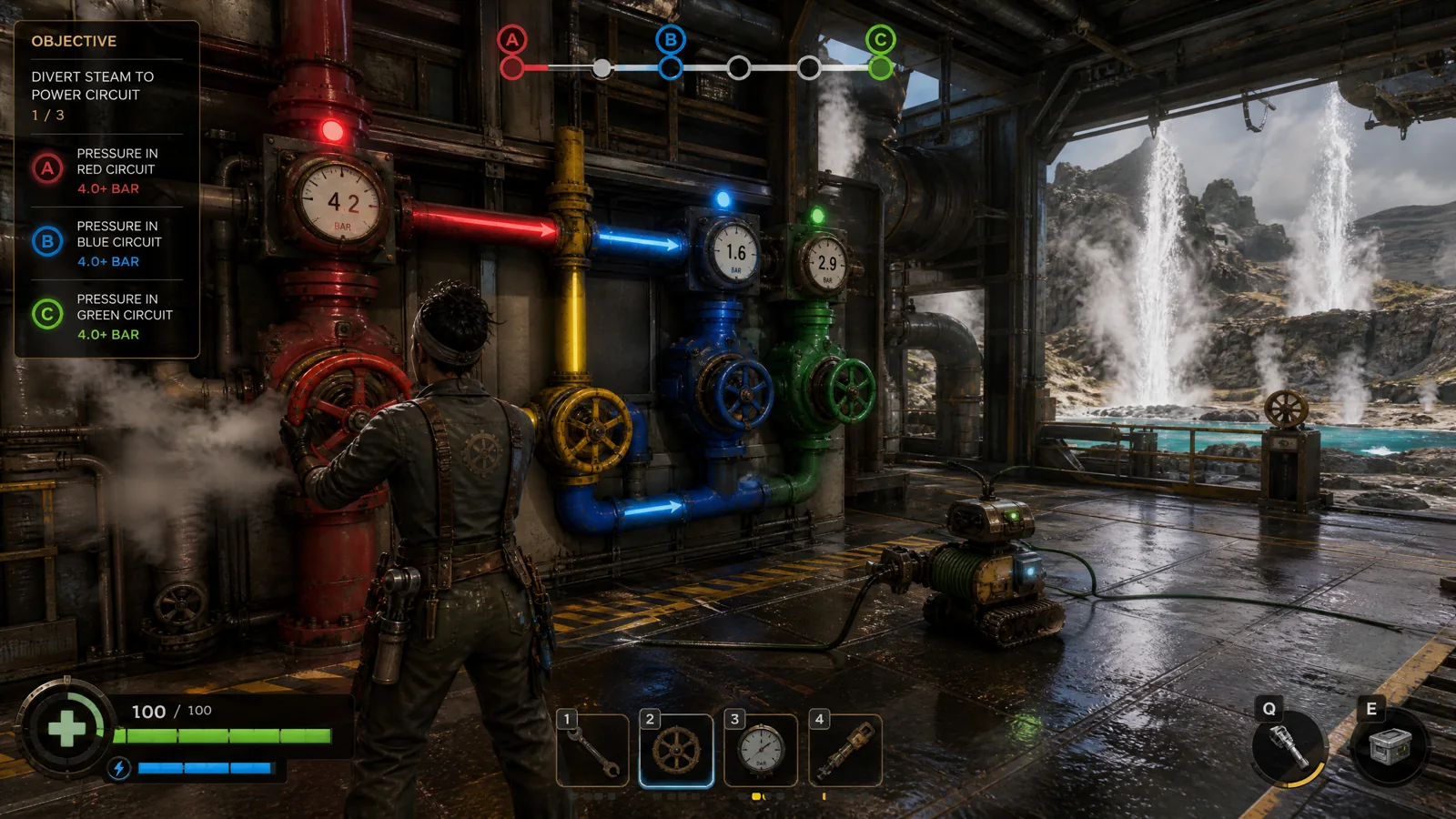
That clarity matters because Rotorua Circuit Breaker is handling several linked systems at once. The on-screen HUD tracks line pressure, circuit continuity and currently equipped tools without drowning the player in noise. In the representative gameplay scene, you are watching steam move through coloured valve junctions while the bot carries cable to a dead panel, and the whole screen communicates a practical chain of problems: redirect pressure, keep the line stable, complete the circuit, then unlock the next physical route. It makes engineering feel legible rather than abstract.
The control scheme reinforces that grounded feel. On PC, movement is crisp on WASD, the camera behaves sensibly on mouse, and the left and right triggers of the experience are effectively split between hands. One side is about tool use and valve interaction, the other is about directing the maintenance bot and reading the environment. On Nintendo Switch 2, the face buttons and shoulder inputs are mapped cleanly enough that swapping from movement to interaction never becomes fiddly. Here, the basics stay comfortable even when the surrounding machinery becomes complicated.
Pressure Puzzles That Build on Themselves
The strongest thing Rotorua Circuit Breaker does is layer its puzzle logic. A red valve is not merely red for the sake of matching; it denotes a line that tolerates stronger bursts but risks heat bloom if left fully open. Blue routes are steadier and safer for fragile circuits, while yellow paths often behave like temporary bypasses that help you split flow before recombining it downstream. Because pressure and circuitry are linked, the solution is rarely as simple as opening the correct gate. You are often trying to create a stable state, not just an open path, and that distinction gives the game its identity.
The maintenance robot is essential to that identity. It is a purpose-built partner tool, and the game gets real mileage from that choice. You can park the bot beside a socket, ask it to brace a loose cable, hold a relay open, or carry a spool through a hot zone while your mechanic circles around to another access point. Those actions create lovely little moments of sequencing. You are staging a repair job across a room full of dependencies, and the robot makes that multitasking tactile.
Better still, the game keeps introducing wrinkles without breaking the underlying language. Later facilities add failing condensers, steam lifts that only stay active under specific pressure ranges, and breakers that save one side of a room by starving the other. Because the game teaches its rules cleanly early on, these additions feel like extensions rather than gimmicks. A good puzzle game leaves players feeling smarter than they were an hour earlier. Rotorua Circuit Breaker consistently delivers that sensation.
| Gameplay element | Why it works |
|---|---|
| Coloured valves | Communicate heat tolerance and flow behaviour at a glance. |
| Pressure HUD | Makes risk readable before failure becomes frustrating. |
| Maintenance robot | Adds sequencing and spatial planning without overcomplicating controls. |
| Cable routing | Turns simple traversal into practical problem-solving. |
Pacing through these sections is deliberate in the best way. Rotorua Circuit Breaker is comfortable letting you stop, scan a room and think. It does not rush to solve its own puzzles for you, and it usually trusts environmental layout over explicit hint spam. There is pleasure in tracing a pipe overhead, noticing a blocked bypass on the far catwalk, then realising the robot needs to bring cable through a side channel before you vent the main line. The game’s biggest successes come from those linked revelations, where several ordinary tasks suddenly click into one elegant answer.
Readable on a Small Screen, Strong on a Big One
The brief promise of good handheld readability is not marketing fluff in this case; it is visible in the way the whole interface has been prioritised. Pressure bars use strong contrast, icons are distinct, and the circuit overlay is drawn with enough thickness that it remains interpretable without squinting. Nintendo Switch 2 benefits most from that restraint. In handheld mode, the game remains easy to parse during busy repair sequences, and the camera sensibly tightens around interactable machinery instead of forcing players to pick tiny hotspots out of a cluttered industrial backdrop.
Performance is solid where it matters. On PC, the game runs smoothly while filling service chambers with steam, sparks and moving machinery, and the frame rate holds up well enough that timing-based valve adjustments feel dependable rather than mushy. On Switch 2, image quality is inevitably softer in portable mode, yet the trade-off is chosen intelligently. Geometry holds together, effects remain readable, and input response stays snappy enough for precise interaction. This is not the kind of third-person game that lives or dies on spectacle, so the smarter win is consistency.
Accessibility support is similarly thoughtful. Colourblind options replace pure colour reliance with clear symbols and patterned line markers, which is essential in a game so invested in valve states. There are toggles for HUD scale, subtitle size, hold-versus-toggle interactions and reduced camera shake, plus enough remapping flexibility that players can redistribute key actions to suit comfort rather than fight the defaults. None of that feels ornamental. In a design this information-dense, accessibility choices directly affect whether the core systems are enjoyable, and the game treats them as central rather than optional.
Rotorua Circuit Breaker is at its best when it lets pressure, wiring and movement speak the same language, because every successful repair feels earned twice: once by observation and once by execution.
Combat Is the Weak Link
The hesitation comes whenever the game decides that puzzle tension is not enough. Combat interruptions arrive in the form of malfunctioning security drones and overheated maintenance units, and they rarely improve the surrounding sequence. The basic dodge, lock-on and stun-shot loop is serviceable, but only just. Encounters are readable enough to survive, yet they lack the same material logic that makes the repair systems compelling. Instead of asking you to think about space and machinery in interesting ways, they flatten the experience into routine crowd control.
That would be less of an issue if these fights were brief punctuation, but they too often break the game’s best rhythm. You can spend several satisfying minutes building a mental model of pressure routes, only to have that concentration punctured by an alarm and a mandatory skirmish. It is not that action has no place in a third-person puzzle game; it is that Rotorua Circuit Breaker has already found a richer source of tension in looming overloads, unstable valves and partial power restoration. Mechanical failure is the drama. Drone clean-up feels like an obligation layered on top.
Even so, the interruptions do not sink the whole project because the repair loop is strong enough to recover each time. Once combat ends and the game returns to managing line pressure, threading cable and commanding the robot, the focus snaps back into place. That resilience says a lot about the quality of the foundation. There is a genuinely excellent puzzle game inside Rotorua Circuit Breaker, and most of the time it is allowed to be exactly that.
A Smart Handheld Puzzle Action Game With One Bad Habit
Rotorua Circuit Breaker earns its 8.0 by making complex systems feel graspable, tactile and satisfying across both PC and Nintendo Switch 2. Its linked pressure puzzles are the clear attraction, its handheld readability is genuinely impressive, and its robot-assisted repair work gives the whole adventure a practical identity that many action puzzle games never find. The controls are dependable, the pacing within puzzle spaces is strong, and the accessibility work shows real care for how players actually read and manage information.
What keeps it from climbing higher is the persistent feeling that it does not fully trust its own strengths. The combat is not disastrous, but it repeatedly interrupts the exact design ideas that make the game memorable. Strip away a handful of those forced fights and Rotorua Circuit Breaker would feel leaner, smarter and more distinctive. As it stands, it is still easy to recommend: a sturdy, thoughtfully built puzzle adventure that turns pressure into something you can read, manipulate and finally master.