
Braving the Swell
The Tasman Sea has never been a particularly forgiving stretch of water, and Long White Wake makes sure you understand that from the moment you take the helm. As a maritime rescue simulation, it trades the high-octane thrills of arcade boat racers for something far more methodical and demanding. Developed for PC, PlayStation 5, and Xbox Series, this is a game about respect—respect for the ocean, respect for your vessel, and respect for the sheer terrifying scale of the natural world when things go wrong. It is an experience that demands your full attention, punishing carelessness with a swift, watery end, yet rewarding patience with some of the most satisfying rescue operations in recent memory.
In Long White Wake, you step into the heavy boots of a search and rescue commander stationed on a rugged, fictionalised stretch of coastline. Your job is to navigate treacherous conditions, locate vessels in distress, and extract survivors before the sea claims them. The premise is straightforward, but the execution is where the game shines, offering a convincing simulation of sea handling and crew prioritisation that feels both grounded and deeply engaging. The moment-to-moment gameplay is less about speed and more about calculated risk management, balancing the urgent need to reach victims against the structural limits of your rescue boat.
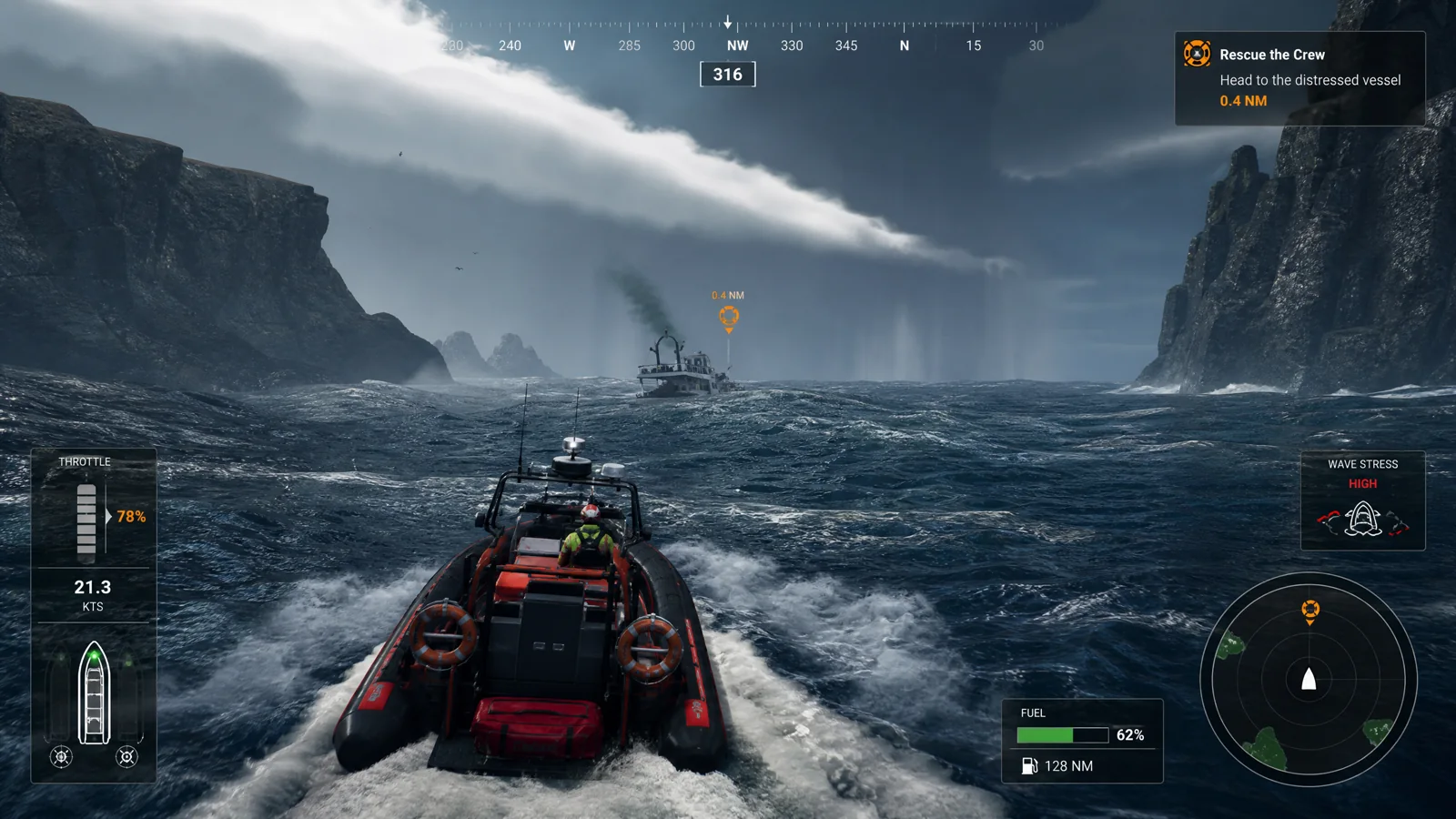
Visually, the game captures the stark, imposing beauty of a remote coastal environment. One particularly memorable scenario involves piloting your rescue boat across rough water, sandwiched between towering, remote cliffs, as you head towards a damaged fishing vessel. The waves here are not just cosmetic; they are physical entities that dictate your every move. The water physics are arguably the star of the show, simulating the chaotic, unpredictable nature of heavy swells with terrifying accuracy. You have to read the water, anticipating the crests and troughs to avoid capsizing or causing catastrophic damage to your hull.
Systems Under Pressure
At the heart of the experience is a robust and uncompromising control scheme. You are not simply pushing an analogue stick to go forward; you are managing a complex array of systems. The HUD provides critical, real-time feedback on your heading, throttle, wave-stress, and fuel levels. Pushing the throttle to the maximum might get you to the distress signal faster, but doing so while slamming into a three-metre swell will redline your wave-stress indicator, potentially causing engine failure or hull breaches. It is a constant, tense negotiation with the elements.
Crew management is equally vital. You are not alone on the boat, and delegating tasks effectively is the difference between a successful rescue and a tragedy. You must assign crew members to monitor the radar, prepare medical supplies, or manage the winch, all while keeping the boat steady. The prioritisation mechanics force you to make difficult calls under pressure. Do you risk sending a crew member out onto the slippery deck to secure a tow line, or do you wait for a momentary lull in the weather? These decisions carry weight, and the game does not shy away from the consequences of poor judgement.
The pacing of Long White Wake is intentionally deliberate. Missions often begin with a long, tense transit out to the search area, allowing the atmosphere to build. The weather dynamic system ensures that conditions can deteriorate rapidly, turning a routine tow job into a desperate fight for survival. This slow build-up makes the eventual discovery of the target—and the frantic rescue that follows—all the more impactful.
To give a clearer picture of what managing a rescue entails, here is a breakdown of the primary systems you must juggle during a standard operation:
- Throttle and Pitch Control: Crucial for riding over large swells without taking on water or damaging the hull.
- Wave-Stress Monitoring: Pushing the boat too hard in rough conditions leads to cumulative structural damage.
- Crew Task Allocation: Assigning personnel to medical, mechanical, or deck duties based on immediate mission needs.
- Fuel Management: Calculating the point of no return, factoring in the extra fuel burn required to tow a damaged vessel.
The Sounds of the Sea
While the visual and mechanical aspects of the game are largely stellar, the audio presentation is a mixed bag. The environmental sound design is phenomenal. The roar of the wind, the sickening crunch of the hull slamming into a wave, and the distant, muffled calls for help all contribute to a deeply immersive atmosphere. Playing with a good headset is highly recommended, as the directional audio can actually help you locate a distress beacon in heavy fog when your instruments are failing.
Unfortunately, the radio chatter and crew dialogue do not meet the same high standard. The voice acting itself is serviceable, but the pool of recorded lines is noticeably shallow. After a few hours, you will start hearing the same frantic updates and weather warnings repeated verbatim. In a game that relies so heavily on building tension and maintaining immersion, these repetitive radio performances stand out as a glaring flaw. It shatters the illusion of a dynamic, unfolding crisis when the coast guard dispatcher uses the exact same phrasing for the fifth time in a single session.
"The ocean in Long White Wake is not a backdrop; it is an active, hostile antagonist that demands your complete respect and constant vigilance."
Performance across platforms is generally solid, though there are minor caveats. On the PlayStation 5 and Xbox Series consoles, the game targets a smooth frame rate and largely achieves it, even when the screen is filled with particle effects from driving rain and crashing waves. The PC version offers a wealth of graphical options, allowing those with high-end rigs to push the water simulation to breathtaking levels of detail. However, there are occasional frame drops on all platforms during the most chaotic rescues, particularly when multiple vessels and dynamic lighting sources are involved.
Accessibility and Final Thoughts
Accessibility is an area where the developers have clearly made an effort, though there is room for improvement. The game includes a variety of difficulty modifiers, allowing players to tweak the severity of the weather, the fragility of the boat, and the strictness of the time limits. There are also comprehensive options for colour blindness and subtitle customisation. However, the complex control scheme can be overwhelming, and while the tutorial is thorough, the sheer number of inputs required to manage the boat effectively might prove a barrier for players with limited motor function.
Despite its flaws, Long White Wake is a remarkable achievement in the simulation genre. It captures the terrifying majesty of the ocean and the quiet heroism of search and rescue work with a level of detail that is rarely seen in video games. The core loop of battling the elements, managing your fragile craft, and pulling survivors from the brink is incredibly compelling. The satisfaction of navigating a damaged vessel back to harbour after a gruelling, hour-long mission is unmatched.
The repetitive radio dialogue and occasional performance hiccups do detract from the overall experience, but they are not enough to sink the ship. The convincing sea handling and the intense, strategic crew prioritisation make this a must-play for fans of methodical, high-stakes simulations. It is a game that will test your nerves, your patience, and your decision-making skills, leaving you with a profound appreciation for those who do this dangerous work in the real world.