
A Masterclass in Co-operative Navigation
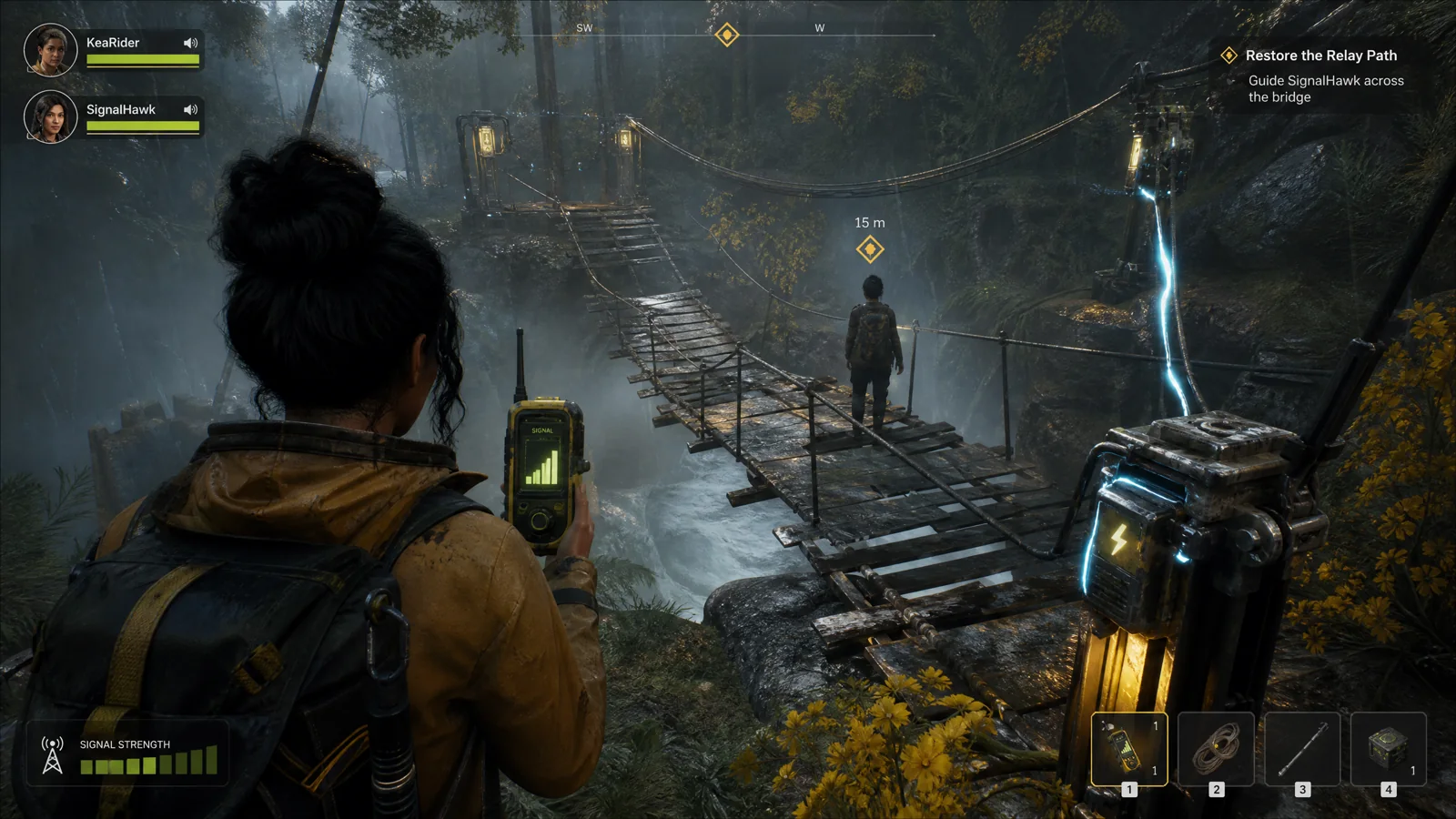
There is a distinct moment in Kōwhai Relay where you realise that traditional co-operative action-adventure mechanics have been entirely subverted. You are standing on the precipice of a broken forest bridge, dense foliage obscuring the path forward, and your teammate is stranded on the other side. Instead of engaging in a tedious fetch quest to find a missing plank or pulling a contrived lever, you raise your handheld signal relay. The over-the-shoulder perspective shifts slightly, focusing on the signal-strength indicator on your co-op HUD. You are not just telling your partner where to go; you are painting a safe path through an otherwise impassable environment, communicating spatially without a single spoken word required. It is a revelation in multiplayer design, proving that co-operation can be profound without devolving into busywork.
For years, the genre has struggled with the balance between meaningful interaction and autonomous play. Too often, games force players into synchronised button presses or asymmetrical roles that leave one person waiting while the other has all the fun. Kōwhai Relay, available on PC, PlayStation 5, and Xbox Series, tackles this issue head-on. By anchoring its core loop around the handheld signal relay, the game transforms navigation into a shared puzzle. The relay allows you to project holographic waypoints, measure environmental hazards, and establish tethered lifelines. It is a robust system that rewards careful observation and clear communication, elevating the simple act of moving from point A to point B into a deeply satisfying collaborative achievement.
Systems and Mechanics: The Handheld Relay
The brilliance of Kōwhai Relay lies in its tactile, responsive controls. Operating the relay feels weighty and deliberate. Using the triggers to adjust signal frequencies while manipulating the thumbsticks to paint waypoints creates a satisfying physical connection to the on-screen action. When guiding a teammate across a treacherous ravine, the haptic feedback on modern controllers provides subtle cues about signal degradation. If the connection weakens, the controller rumbles with increasing intensity, warning both players to adjust their positioning before the holographic bridge collapses. This sensory feedback loop ensures that you are always engaged with the environment and your partner.
Furthermore, the game introduces a suite of flexible assist tools that cater to a wide range of skill levels and communication styles. For players who prefer not to use voice chat, the ping system is remarkably robust. A quick tap of the bumper highlights points of interest, while holding the button opens a radial menu of context-sensitive commands. These visual cues are integrated seamlessly into the world, appearing as glowing augmented-reality markers rather than intrusive UI elements. This commitment to diegetic design keeps you immersed in the lush, overgrown environments while ensuring that both players are always on the same page.
However, the reliance on the relay system does present some initial friction. The opening hours of the game are undeniably slow, bogged down by exhaustive tutorials that attempt to explain every nuance of the signal mechanics. While the intention is clearly to ensure that neither player is left behind, the execution feels overly cautious. You spend the first chapter restricted to basic pinging and linear paths, waiting for the game to take the training wheels off. It is a pacing issue that threatens to alienate impatient players, but those who push through are rewarded with a beautifully complex interplay of mechanics in the later stages.
Pacing, Progression, and the Slow Burn
Once Kōwhai Relay opens up, the pacing improves dramatically. The environments transition from restrictive corridors to sprawling, multi-tiered arenas that demand creative problem-solving. You might find yourselves separated by a rushing river, requiring one player to manipulate the environment using the relay while the other navigates a series of precarious platforms. These scenarios are masterfully constructed, often featuring multiple solutions that encourage experimentation. The progression system is tied directly to the mastery of the relay, unlocking new frequencies that allow you to interact with different environmental elements.
"The genius of the relay system is that it never treats communication as a barrier; rather, it turns the act of sharing information into the primary gameplay loop, making every successful traversal feel like a hard-won victory."
Combat in Kōwhai Relay takes a backseat to exploration and puzzle-solving, which is a refreshing change of pace for the genre. When hostile encounters do occur, they are treated as extensions of the navigation mechanics. Enemies are typically environmental hazards—swarms of aggressive insects or automated security drones—that must be bypassed or neutralised using the relay. For example, one player might need to use a high-frequency pulse to stun a drone while the other slips past to disable its power source. It is a system that emphasises coordination over reflexes, ensuring that both players remain integral to the encounter.
Performance, Polish, and Accessibility
From a technical standpoint, Kōwhai Relay is a remarkably polished experience. On the PlayStation 5 and Xbox Series X, the game targets a rock-solid 60 frames per second, which is crucial for the precision required during complex platforming sequences. The PC version is equally impressive, offering a wide range of graphical settings and robust support for ultrawide monitors. The visual design is striking, contrasting the decaying, brutalist architecture of a forgotten civilisation with the vibrant, reclaiming overgrowth of nature. The lighting engine is particularly noteworthy, as the glow of the relay cuts through dense fog and shadowy caverns.
Accessibility is another area where the game excels, setting a new standard for the genre. The developers have clearly prioritised inclusivity, offering a comprehensive suite of options that can be tailored to individual needs.
- Visual Aids: High-contrast modes for the relay signal and environmental hazards, ensuring readability in visually busy areas.
- Motor Accessibility: Fully remappable controls, toggle-to-hold options for sustained relay usage, and generous aim assist for waypoint placement.
- Cognitive Support: Adjustable puzzle timers and the ability to pin current objectives directly to the HUD without cluttering the screen.
- Audio Cues: Directional subtitles and distinct audio tones for different relay frequencies, allowing players to navigate by sound alone if necessary.
These features are not tucked away in obscure sub-menus; they are presented upfront during the initial setup, encouraging players to customise their experience from the outset. This proactive approach to accessibility ensures that the core mechanic—communication—is never hindered by physical or cognitive barriers.
A Triumphant Step Forward for Co-op
Despite its sluggish opening chapter, Kōwhai Relay ultimately delivers one of the most compelling cooperative experiences in recent memory. It asks you to trust your partner, to communicate clearly, and to think spatially in ways that few other games demand. The satisfaction of successfully guiding a teammate across a crumbling precipice, relying solely on the strength of your signal and the clarity of your intent, is unparalleled. It is a game that understands that the true joy of multiplayer lies not in simply sharing a screen, but in sharing a struggle and overcoming it together.
By stripping away the busywork and focusing entirely on the mechanics of connection, Kōwhai Relay earns its 8.6 score. It is a bold, innovative title that challenges the conventions of the action-adventure genre, proving that sometimes the most powerful weapon in a game is simply the ability to point the way forward. For players seeking a deep, thoughtful cooperative journey that respects their intelligence and their time, this is an essential addition to the library. Just be prepared to weather the slow start, and you will find a beautifully crafted world waiting to be explored, one relay signal at a time.