
The Allure of the Transparent Heist
There is a distinct tension that comes with being entirely visible. In most stealth games, the shadows are your steadfast allies, thick enough to conceal a multitude of sins and sloppy movements. Harbour Glass strips away this comfort, dropping players into a first-person immersive sim where the architecture itself is the primary adversary. Set across a sprawling, hyper-modernised waterfront district, the game asks a simple but punishing question: how do you ghost through a facility built almost entirely of glass?
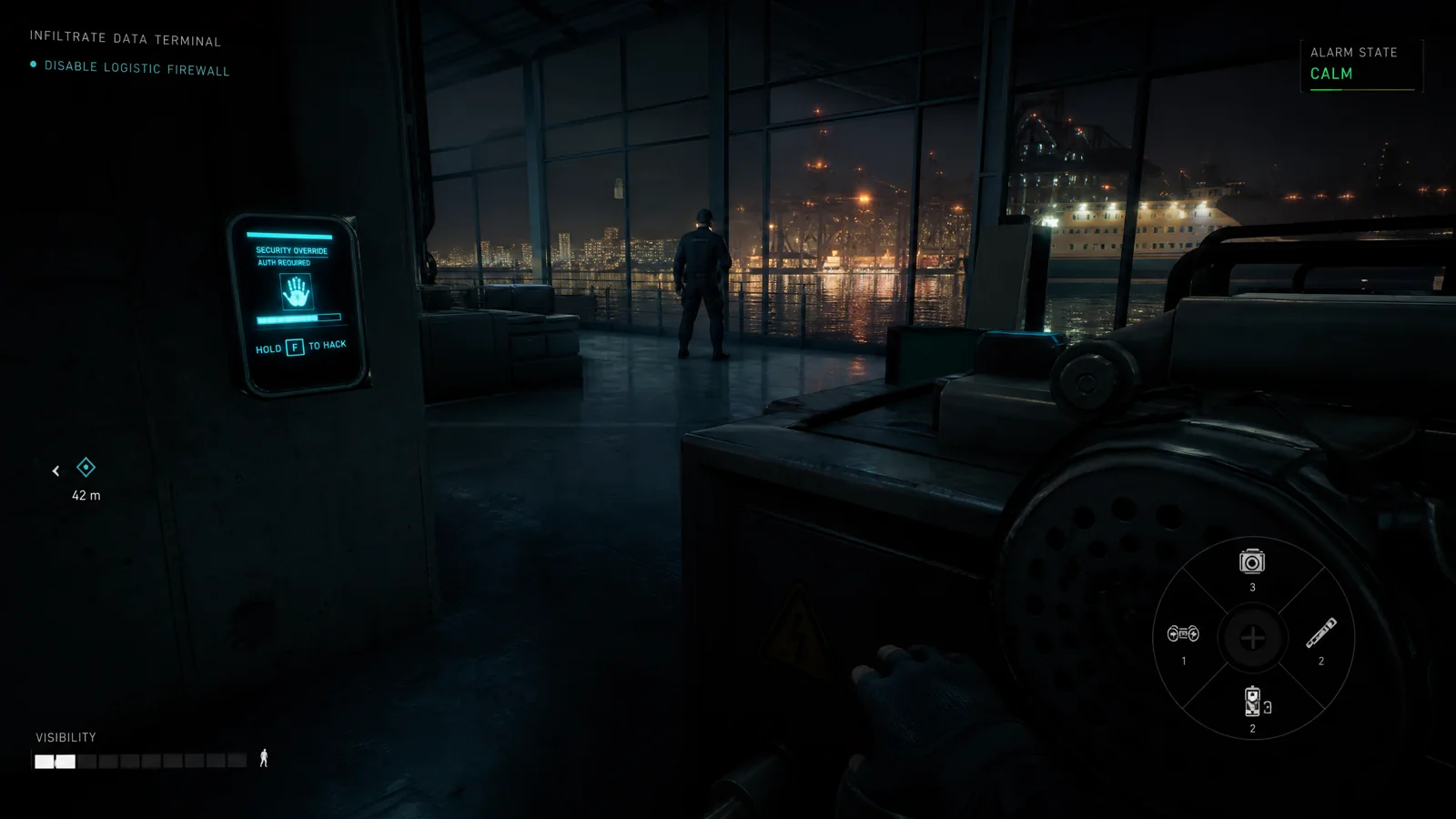
This premise is the beating heart of an experience that rewards patience and penalises recklessness. You are not a super-soldier or a shadow-walking assassin; you are an infiltrator relying on systemic gadgets, spatial awareness, and a meticulous understanding of sightlines. When you find yourself crouched inside a transparent waterfront data terminal, watching a patrolling guard walk past mere inches from your face, the thrill is undeniable. The visibility HUD pulses a warning amber, your gadget wheel offers a dozen different ways to manipulate the environment, and the alarm meter threatens to end your perfect run. It is a masterful execution of a singular, terrifying concept.
Sightlines and Systemic Puzzles
The core gameplay loop of Harbour Glass revolves around observation and manipulation. The game's levels are sprawling, multi-tiered puzzles where every reflective surface and transparent wall must be accounted for. You cannot simply memorise patrol routes; you must understand the geometry of the space. A guard on a gantry two floors up might spot your reflection in a polished server rack if you move too quickly. This forces a deliberate, almost meditative pacing that stands in stark contrast to the kinetic energy of modern action games.
To survive this glasshouse, you are equipped with a suite of systemic gadgets that interact dynamically with the environment. The standout tool is the refraction emitter, a deployable device that bends light around a small radius, creating temporary blind spots. It is not a magic invisibility cloak—it consumes battery rapidly and emits a low hum that can attract attention—but it provides just enough breathing room to hack a panel or slip past a checkpoint. Combined with acoustic dampeners and thermal decoys, the gadgetry encourages creative problem-solving rather than brute-force progression.
The hacking minigame, often a tedious afterthought in the genre, is brilliantly integrated into the physical space. When you interface with a terminal, the game does not pause or pull you into an abstracted screen. Instead, the hackable panel projects a holographic interface into the world, meaning you must manage the hack while keeping one eye on the patrolling guards through the glass. It is a nerve-wracking multitasking challenge that perfectly encapsulates the game's commitment to vulnerability.
"Harbour Glass doesn't just want you to hide; it wants you to understand the architecture of your own exposure, turning every pane of glass into a potential betrayer."
The Flaw in the Glass: Inconsistent Audio
For a game so meticulously crafted around sensory awareness, it is deeply frustrating that Harbour Glass falters in its sound design. In a stealth game, audio cues are just as critical as visual indicators. You need to know exactly where a guard is based on the crunch of their boots or the static of their radio. Unfortunately, the directional audio here is wildly inconsistent, breaking the immersion and leading to unearned failures.
Footsteps often sound as though they are coming from the same room when the guard is actually on the floor above. Conversely, a guard rounding a corner might make no sound at all until they are already spotting you. In a game where you are constantly managing your visibility HUD and monitoring complex sightlines, you must be able to trust your ears. When that trust is broken, the resulting alarms feel less like a consequence of your own mistakes and more like a betrayal by the game's mechanics. It is a significant blemish on an otherwise stellar mechanical foundation.
Performance, Controls, and Accessibility
On the PlayStation 5 and Xbox Series consoles, Harbour Glass offers a choice between a 30fps fidelity mode and a 60fps performance mode. Given the precision required for timing movements between guard patrols and managing the gadget wheel under pressure, the performance mode is absolutely essential. The fluid frame rate makes tracking sightlines and executing split-second hacks significantly more manageable. PC players with robust hardware will find a beautifully optimised experience, though the extensive use of ray-traced reflections can tax older GPUs heavily.
The controls are mapped with a deep understanding of the genre's demands. The dedicated lean buttons allow you to peek around corners without exposing your entire hitbox, and the gadget wheel slows time just enough to let you make tactical decisions without breaking the flow of gameplay. Navigating the environment feels weighty and deliberate; you cannot mantle up ledges with superhuman speed, reinforcing the grounded reality of your infiltration.
Accessibility options are surprisingly robust for a game with such a punishing reputation. The developers have included granular sliders for enemy perception, allowing players to adjust both visual and auditory detection speeds independently. There are also high-contrast modes for the HUD and crucial interactables, which is a godsend when trying to locate a hackable panel in a visually noisy server room. These features ensure that the core tension of the game remains intact while accommodating a wider range of players.
A Calculated Risk
The brilliance of Harbour Glass lies in its commitment to its central thesis. It does not compromise its vision to appeal to action fans; it demands that you play by its rules. The waterfront district is a character in itself, a cold, calculating labyrinth of steel and glass that tests your spatial reasoning at every turn. When a plan comes together—when you deploy a refraction emitter, hack a terminal, and slip through a closing security door just as a guard turns their head—the sense of accomplishment is unparalleled.
However, the inconsistent guard audio remains a persistent thorn in the side of the experience. It forces a reliance on the visual HUD that slightly undermines the organic, immersive qualities the game strives for. You find yourself watching the amber and red indicators rather than listening to the world around you, which is a shame given the atmospheric quality of the ambient soundtrack and environmental noise.
Key Takeaways
- Strengths: Masterful level design built around sightlines, deeply systemic gadgets that encourage creativity, and tense, diegetic hacking mechanics.
- Limitations: Unreliable directional audio for guard footsteps, occasional AI pathing quirks, and heavy performance demands in ray-tracing modes.
- Best Played: In performance mode with headphones, utilising the granular difficulty sliders to balance the audio inconsistencies.
Ultimately, Harbour Glass is a triumph of specific, targeted design. It is a stealth game that strips away the shadows and forces you to confront your own visibility. It asks for your patience, demands your attention, and rewards your ingenuity. For fans of the immersive sim genre, it is a brilliant, flawed, and utterly compelling heist that will keep you holding your breath long after the final data terminal has been hacked.